Water Heaters
Tankless vs. Tank Water Heaters: Which Is Right for Your NJ Home?
An honest comparison for North Jersey homes: how each works, where tankless wins and where a tank wins, the gas line and venting a tankless install needs,.
By Master’s Plumbing 6 min read
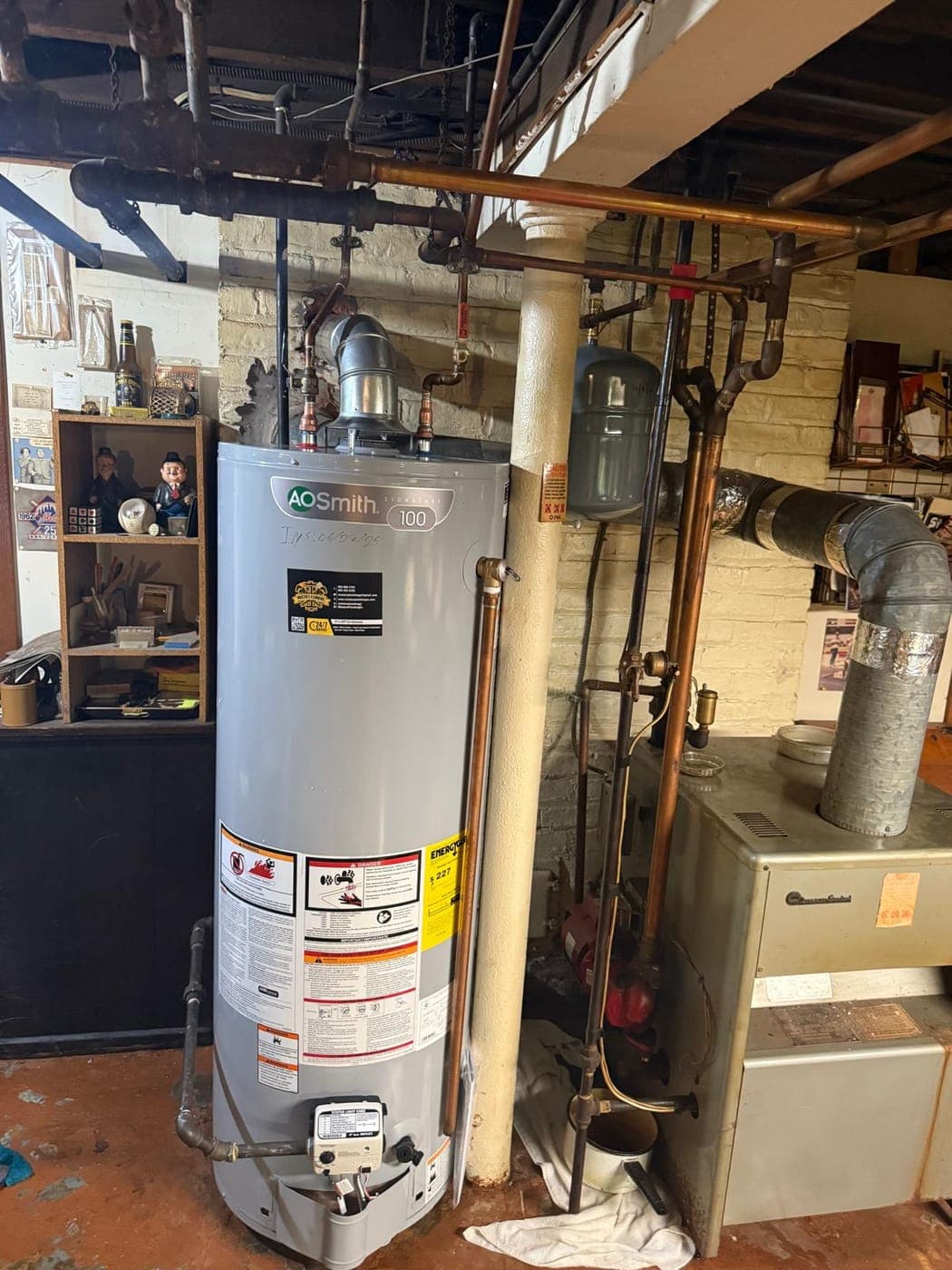
When a water heater fails, most homeowners want the same thing back that was there before, and often that is the right call. But a replacement is also the one moment when switching to tankless is practical, so it is worth an honest look. Here are the real differences, without the sales pitch, and how we help you decide.
How each one works
A tank heater stores a volume of hot water, forty or fifty gallons in most homes, and keeps it hot around the clock, reheating as you draw it down and as it loses heat through the tank walls. When the tank is empty, you wait for it to recover.
A tankless heater has no storage. When you open a hot tap, water flows through a heat exchanger and a large burner fires to heat it on the way through. It heats for as long as the tap is open and stops when it closes. Nothing is stored, and nothing is kept hot while you sleep.
Where tankless wins
- Endless hot water at a given flow rate. Back-to-back showers do not run cold, as long as you do not exceed what the unit can supply at once.
- No standby loss. A tank spends energy keeping water hot at 3 a.m. A tankless unit does not.
- Space. A wall-mounted unit about the size of a carry-on suitcase frees up a corner of the basement.
- A longer service life is typical, and most components are replaceable, where a leaking tank is done.
- No tank to rupture. A failed tank can dump its entire contents on the basement floor.
Where a tank wins
- Simpler installation. A like-for-like tank swap uses the existing gas line, venting and water connections. It is a shorter job.
- Lower upfront cost in almost every case, once the gas and venting work for tankless is counted.
- Flow rate. A tank can feed a shower, the dishwasher and a faucet at once from stored water. A tankless unit sized too small drops temperature when several fixtures run together, especially in winter when incoming water is much colder.
- Works with the house as it is. Tankless often needs changes to the house, not just the heater.
- Simple maintenance. Flush the sediment, check the anode rod. Tankless has a stricter maintenance requirement.
- Power outages. A standing-pilot tank heater keeps working with no electricity. Tankless needs power for its controls and fan.
What tankless needs from your house
This is the part that decides most North Jersey installations.
Gas supply
A tankless unit fires at several times the input of a tank heater because it heats all the water instantly. Many homes, especially older ones with a half-inch gas line to the water heater, do not have enough gas capacity on that run. Often the line has to be upsized from the meter, or a new dedicated line run, and sometimes the meter itself has to be checked with the utility for capacity. This is licensed gas plumbing work and it is a real part of the job.
Venting
Tank heaters usually vent into the chimney or a metal flue. Condensing tankless units vent through PVC to an outside wall or the roof and need an intake as well. Non-condensing units need stainless venting. Either way, the old chimney flue usually cannot be reused, and if the water heater was the only appliance on that chimney, the chimney may need to be capped or lined. We look at where the unit can go relative to an exterior wall before quoting.
Electrical and condensate
Tankless needs a standard outlet nearby and, for condensing units, a condensate drain, which may need a neutralizer and a small pump if there is no floor drain close by.
Hard water and maintenance
Much of North Jersey has moderately hard municipal water. Scale builds inside the narrow passages of a tankless heat exchanger faster than inside a tank, reducing output and eventually causing faults. A tankless unit should be descaled about once a year by circulating a descaling solution through it with a small pump, using the isolation valves we install for that purpose. In homes with harder water, a softener or a scale-reducing filter ahead of the unit is worth discussing.
A tank heater should be flushed annually too, and its anode rod checked every few years, but skipping that costs you a shorter tank life rather than an outright shutdown.
Sizing for a multi-bathroom home
Tankless units are rated by how much water they can heat per minute at a given temperature rise. In winter, water arrives at a North Jersey house cold, so the rise needed to reach shower temperature is large and the unit delivers fewer gallons per minute than it does in summer. A unit sized from a summer brochure will struggle in January.
For a home with two showers, a dishwasher and a laundry that could run together, we size for the realistic peak, usually two showers at once, and we size against winter inlet temperature rather than the average. Sometimes that means a larger unit, sometimes two units in parallel, and sometimes the honest answer is that a well-sized tank, or a tank with a higher recovery rate, fits the household better.
Low-flow fixtures help tankless. A house full of older high-flow shower heads works against it.
How to think about cost
We do not quote prices in an article because every house is different, but the shape of the decision is consistent. Tankless costs more up front, and the gap is mostly the gas and venting work, not the heater. It costs less to run because there is no standby loss, and it typically lasts longer, so the gap narrows over the life of the unit. Whether it closes depends on how much hot water your household uses, how long you plan to stay in the house, and how much the installation requires.
A tank swap is the lower-cost, lower-disruption choice, and for a family that has never run out of hot water and does not plan to be in the house long, it is often the right one. Tankless makes the most sense for households that run out of hot water, that are renovating and rerouting anyway, that want the space back, or that plan to stay long enough to see the operating savings.
How we help you decide
On a replacement call we look at the gas line size and meter, where the unit can vent, water hardness, how many bathrooms and people the house has, and whether you have been running out of hot water. Then we quote both options with a firm by-the-job price, tell you what each involves, and let you pick. We install tank and tankless heaters from all major brands, handle the permits and inspections, and stock replacement tanks for same-day installs when the old one is leaking.
When to call Master's Plumbing
If your water heater is leaking or failing, call 862-666-2155 any time; no hot water in winter is treated as an emergency. If it is still working and you are weighing tank versus tankless before it fails, call to schedule an assessment. That is the best time to plan the gas and venting work, and it beats deciding in a hurry with a wet basement floor.
Related services
- Water HeatersNo hot water or a leaking tank? Master's Plumbing repairs and replaces gas, electric and tankless water heaterLearn more
- Gas LinesSmell gas? Leave, call your utility, then call 862-666-2155. Master's Plumbing repairs gas leaks and runs new Learn more
- Water SoftenersScale on fixtures, spotted glasses, a water heater full of sediment? Master's Plumbing installs and services wLearn more
- MaintenanceAnnual plumbing inspections, water heater flushes and pre-purchase checks across North Jersey.Learn more